
WEB APP
Transforming HVAC Control Through a Smart Building Management System (BMS)
COMPANY
Daikin
ROLE
UX/UI Designer
INDUSTRY
IoT

Project description
A smart Building Management System (BMS) designed to help facility teams monitor, control and optimize HVAC operations across zones in real-time. The platform centralizes building climate data, enables quick temperature and mode adjustments, automates schedules, and visualizes energy consumption through interactive analytics. The goal was to increase operational efficiency, reduce energy wastage, and create a scalable solution that supports multiple user roles, building types and system configurations.
Timeline
Background
From explorations to final designs in 6 weeks while working with multiple projects at the same time.
This project was initiated to design a smart Building Management System (BMS) that centralizes HVAC control into a single interface — enabling real-time monitoring, scheduling automation, system configuration, and energy analytics. The platform’s objective is to improve operational efficiency, reduce electricity consumption, and help organizations maintain comfortable indoor environments effortlessly.
Process
I started by understanding how facility teams currently manage HVAC systems and identifying their core challenges through research. Insights shaped the user journeys and information architecture, followed by wireframes to validate flow and usability. These were refined into high-fidelity UI designs with a scalable design system, ensuring clarity, consistency, and intuitive monitoring across dashboard, zone control, scheduling, and analytics.


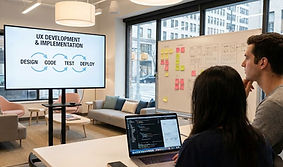
Research & Planning
Design & Prototyping
Development & Implementation
Testing & Optimization
I began by understanding how HVAC systems are managed through stakeholder discussions and studying on-ground workflows. Competitive analysis helped benchmark existing BMS solutions and highlight usability strengths and gaps. These insights shaped user needs, feature priorities, and the foundation for project scope.
User flows shaped the wireframes, ensuring that common tasks like zone control and scheduling were quick to access. High-fidelity UI brought visual clarity through clean cards, sliders, and charts. The clickable prototype enabled flows to be tested across dashboard and settings scenarios.
Designs were handed off with detailed UI components, specs, and states for smooth development. Modules like Dashboard, Zone Control, Scheduling, and Analytics were implemented in structured phases. Continuous collaboration ensured accurate implementation and a consistent, scalable product experience.
User feedback sessions highlighted improvements for scheduling flow, alert visibility, and quick controls. UI adjustments were made to enhance readability and reduce clicks for common actions. The final design achieved better usability through simplified layouts and improved priority cues.
Solutions
The solution centralizes HVAC control with live monitoring, automated schedules, and energy insights. A clean UI with role-based access improved decision-making and enabled proactive building management.
Centralized HVAC Monitoring Dashboard
Zone-Based HVAC Control & Quick Actions
Smart Scheduling & Automation
Energy Analytics & Decision Insights
A unified dashboard was created to visualize building climate data such as temperature, humidity, air quality, and live system status. Facility teams can monitor multiple zones at once instead of checking manually. Alerts and status indicators help operators respond instantly to anomalies and maintenance needs.
The solution enables easy temperature control, mode switching (Auto/Cool/Heat), and fan adjustments per zone. Occupancy indicators support energy-aware decisions, minimizing unnecessary cooling. The interface is built for speed — allowing technicians to take actions without navigating deep menus.
A time-based scheduling module was implemented to automate HVAC operation during working hours, events, or specific room requirements. It reduces manual effort and prevents energy wastage when zones are unused. Simple create/edit controls ensure schedules can be updated effortlessly.
Visual consumption analytics help identify peak usage times, zone inefficiency, and cost patterns. Data-driven insights enable smarter decision-making and long-term energy optimization. Comparative graphs and efficiency scoring make it actionable for management as well as technicians.


Prototype:
Results
The solution improved operational visibility by centralizing HVAC monitoring and controls into a single platform. Automated scheduling and quick zone actions reduced manual effort and energy wastage. Clear analytics enabled facility teams to make faster, data-driven decisions.
Improved Operational Efficiency
Reduced Energy Waste & Cost Optimization
Faster Maintenance & Proactive Issue Resolution
Better Data-Driven Decision Making
Centralized HVAC monitoring and controls replaced manual, zone-by-zone operations with a single unified dashboard. This streamlined daily workflows and enabled quicker responses across facility teams.
Impact: ⏱️ ~30–40% reduction in manual operational effort, ⚡ faster response time to zone-level actions.
Automated scheduling and occupancy-based controls minimized unnecessary HVAC runtime and improved energy usage patterns. Analytics helped identify peak loads and inefficiencies for better optimization.
Impact: 💡 ~15–25% reduction in energy consumption, 💰 noticeable monthly cost savings through optimized usage.
Real-time alerts and system status indicators allowed teams to identify and address HVAC issues earlier. This reduced reactive maintenance and improved system reliability.
Impact: 🛠️ ~35% faster issue identification, 🔔 reduced unexpected HVAC downtime and maintenance delays.
Clear visual analytics converted complex energy data into actionable insights for planning and optimization. Teams could track performance trends and efficiency at both zone and building levels.
Impact: 📊 Improved planning accuracy, 🎯 clearer efficiency tracking with measurable performance benchmarks.